Geoenergy
|
Ansprechpartner: Prof. Dr. Thomas Kohl
+49 721 608 45220 |
The Geoenergy Division, in close collaboration with the Geothermal Energy & Reservoir Technology Division at the AGW, is conducting research into two geothermal key technologies for sustainable heat supply: the utilisation of geothermal energy from fractured crystalline reservoirs and high-temperature heat storage deep underground. Our work combines geological and geophysical subsurface characterisation, laboratory experiments and numerical methods, right through to digital twins. It is closely integrated into the development of two large-scale research infrastructures.
Research infrastructures GeoLaB and DeepStor
Our research focuses on the GeoLaB and DeepStor infrastructures, in the development and scientific utilisation of which the department plays a key role. The planned GeoLaB underground research laboratory will enable experiments to be carried out in crystalline rock under real-world conditions. The focus is on understanding flow and transport processes in fractured reservoirs. DeepStor is dedicated to research into high-temperature aquifer thermal energy storage (HT-ATES). Here, researchers are investigating how heat can be stored seasonally in deep rock layers and retrieved as and when required.
You can find the GeoLaB website here.
Here you can find the DeepStor website, which also provides information on the drilling currently underway.
Geological and geophysical subsurface characterisation
A sound understanding of the subsurface forms the basis for any geothermal utilisation and the development of research infrastructure. As part of the GeoLaB project, we carry out geological investigations and geophysical measurements, including geomagnetic and geoelectric methods. For DeepStor, we characterise potential storage formations in terms of their geological and hydraulic properties.
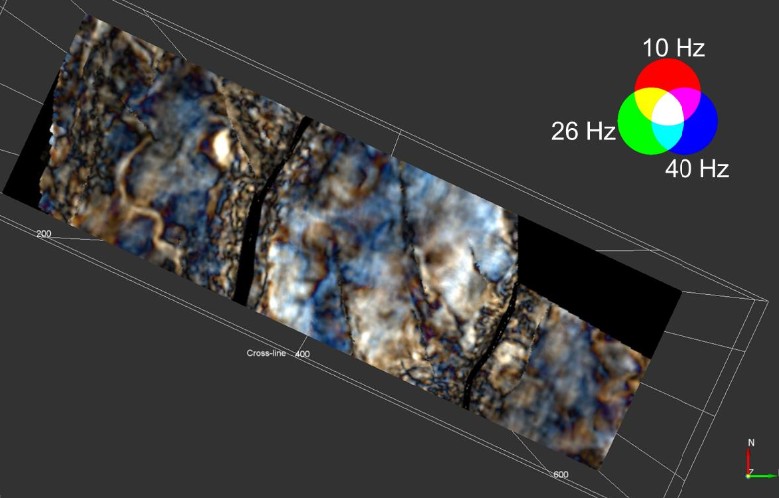
In addition, seismic data is interpreted to map the structural geological conditions of the subsurface. To characterise potential storage horizons in the Upper Rhine Graben, we analyse 3D seismic data using advanced analytical methods. This allows us to visualise structures that cannot be resolved using conventional interpretation methods. The geometries obtained in this way improve our sedimentological understanding of the rift fill. They also provide boundary conditions for the thermal-hydraulic modelling of high-temperature aquifer thermal energy storage systems in the peripheral areas of former hydrocarbon reservoirs, such as those being investigated in the DeepStor project.
Laboratory experiments on fracture flow
The hydraulic properties of crystalline reservoirs are largely determined by fractures. In laboratory experiments, we investigate flow through fractures with rough surfaces. To this end, we use the RockBlockEx and F4aT Lab (Forced Fracture Fluid Flow and Transport) test rigs at the Institute of Applied Geosciences (AGW). The results help to improve our understanding of flow processes within the reservoir and to represent them in numerical models.
We are investigating whether fluid flow within a rough rock fracture can be detected via acoustic emissions. To this end, water (at varying opening widths or offsets) or CO₂ is passed through the fracture in the F4aT Lab test rig at AGW, whilst twelve sensors on the specimen and three further sensors on the test bench record the signals at a sampling rate of 50 and 62 kHz respectively. The measurements are analysed using a machine learning method.
In RockBlockEx, a granite block approximately 50 cm in size is clamped in a steel frame and subjected to differential stresses of up to 20 MPa using hydraulic flat presses. A single crack is created by hydraulic injection, and its formation and flow through the crack are monitored using acoustic emissions, electrical and electromagnetic signals, as well as pressure and temperature measurements.
Numerical Modelling and digital twins
For GeoLaB and DeepStor, we are contributing to the development of digital twins that integrate exploration data, geological models and process simulations within a single environment. Virtual reality methods provide an intuitive way of accessing complex subsurface data.
In the GeoDT project, this concept is being developed and demonstrated as a prototype using the Tromm in the Odenwald, the designated site region for GeoLaB, as a case study. The digital twin continuously incorporates site exploration data and thus always reflects the current state of knowledge. A distinctive feature is the integration of geoscientific and geotechnical aspects: in cooperation with industry partners, digital drilling technology methods are already being integrated, with their simulation forming a key focus at KIT.
In the DeepStor case study, a physics-based, data-assimilating digital twin is also being developed for high-temperature aquifer thermal energy storage (HT-ATES). This is based on a reservoir model calibrated using core, borehole measurement and test data from the DeepStor borehole, as well as laboratory and in-situ experiments. A coupled thermal-hydraulic-mechanical-chemical (THMC) simulation approach models the key subsurface processes. Machine learning-based models are intended to enable rapid forecasts, sensitivity analyses and the quantification of uncertainties. A further objective is the development of a reservoir management system for decision support, capable of optimising storage operations and evaluating alternative reservoir configurations from a technical and economic perspective.