
GeoDT: Digital Twin – Deep Geothermal Energy – Development of a Prototype for the GeoLaB Site
- contact:
Victor Häfner
- funding:
BMFTR
- Partner:
Karlsruher Institut für Technologie (KIT) – Institut für Nukleare Entsorgung
Christian-Albrechts-Universität zu Kiel, Institut für Geowissenschaften
Helmholtz-Zentrum für Geoforschung - GFZ, Sektion Geoenergie
Rheinisch-Westfälische Technische Hochschule Aachen (RWTH), Lehrstuhl für Numerische Geowissenschaften, Geothermie und Reservoirgeophysik
Fraunhofer IEG - Institution for Energy Infrastructures and Geothermal Systems
Technische Universität Darmstadt, Institut für Angewandte Geowissenschaften
Helmholtz-Zentrum für Umweltforschung GmbH UFZ, Department für Umweltinformatik
- startdate:
2025
- enddate:
2028
The aim of GeoDT is to develop and implement concepts for digital twins (DT) of deep geothermal systems. A digital twin fulfils several complementary functions.
Data integration: The digital twin consolidates data sets into a consistent structure. Initially, data from site exploration is integrated, including geological, geophysical and hydrogeological data, as well as data on groundwater characteristics. As exploration progresses, further data sets are continuously incorporated. In this way, the digital twin represents the current state of data and knowledge.
Modelling and simulation: Furthermore, various simulation systems are integrated into the digital twin, in particular geological modelling and process simulation. Geological modelling provides the structural geological and geometric foundations for data management and process simulation. Process simulation, in turn, is used to interpret geophysical measurement data. In the future, it will be used to design in-situ experiments and a deep geothermal system.
Visualisation: The concept is embedded in virtual and extended reality methods. These enable visual and intuitive access to the complex geological and process data and allow them to be presented within a unified geological context.
Unique selling point: A defining feature of GeoDT is the integration of geoscientific and geotechnical aspects within the digital twin. In addition to the digital representation of the geological system – including hydrogeological, geothermal and geomechanical processes – digital drilling techniques are being integrated in collaboration with industry partners during exploratory drilling.
Prototype: The methodology is being developed using the Tromm region in the Odenwald as a case study and demonstrated using a prototype. GeoLaB, the underground research laboratory for deep geothermal energy, is planned to be established in this region.
Focus at KIT: KIT’s contribution lies in the simulation of drilling technology. The focus is on the mechanical and kinematic processes involved in vertical drilling, as well as the hydraulic systems: the drill string, the mud system and the blowout preventer. The aim is to develop a comprehensive configurator and simulator that provides significant support for the planning and validation of deep drilling projects.
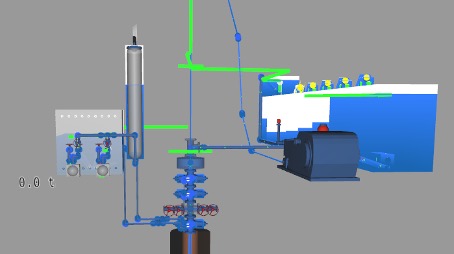
Hydraulic simulation of two circuits: The drilling fluid circulates in the flushing circuit, while in the hydraulic circuit, the accumulator actuates the blowout preventer (BOP). Source: V. Häfner